Where to live in London with children: look for a quieter home and a park you will use
Compare parks, school walks and noise when choosing a London home with children. Check the bedroom, playground entrance and everyday family routes.
By the notbad project · reviewed . Data dates are listed separately.
Explore your family shortlistIn this guide
When choosing where to live in London with children, imagine the walk to the park after school, with a tired child, shopping bags and rain on the way. Would you still go?
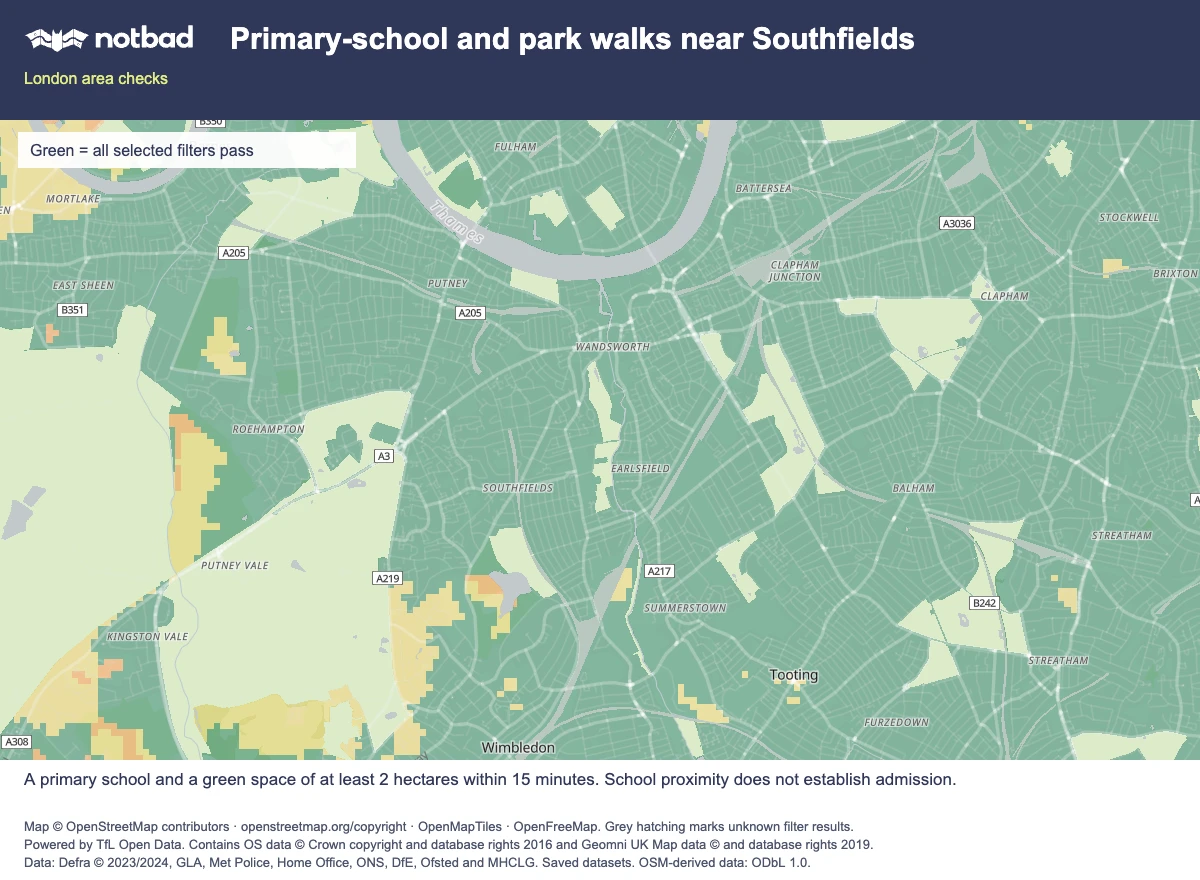
2 applied preferences · green means all selected filters pass
Filters: Walk to green space: 15 min · At least 2 ha; Walk to a school: 15 min · 1 phases · All grades.
Open this exact map searchExample search, not a home recommendation. Saved data may change.
Map © OpenStreetMap contributors · OpenMapTiles · OpenFreeMap. Map and data sources.
Compare that everyday route alongside the school run and the child's bedroom at bedtime. A parent's commute has to fit too. A shortlist of specific locations lets you weigh those needs before trying the rooms and routes as a family.
Describe the weekday you need the location to support
Write down who goes where, when and with whom. With a baby, you may need a manageable pushchair route and somewhere nearby to spend an hour outside. At primary-school age, the school run may have to fit before a parent's commute; an older child may need different transport or a route they can learn to use independently.
Decide which journeys must be short enough to walk and where you could compromise. You might accept a longer station walk to be nearer a useful park while keeping the school run short. Compare your green-space requirements and relevant noise sources around the same home.
Choose the park entrance and the activity
Do you want a playground, space to kick a ball, a woodland walk or somewhere to sit with a baby? Choose the activity first. A large green patch on the map may lack the facility you would use most often.
In notbad, set a minimum mapped green-space size and a maximum walk. The estimate reaches a path within a qualifying space. Check the playground separately for age suitability, equipment and the extra walk to reach it.
Merton Council lists play areas, toilets, sports facilities and several entrances at Wimbledon Park. Identify the entrance and facility you would use, check current access information, and walk that route.
Check crossings, steps and gates on the way. Inside, look for paths that work with your pushchair or child's walking pace, plus the shade, seating and stopping places you need.
A short school walk leaves the admissions question open
Select schools for your child's age and educational needs. Read the current school information and inspection report, noting its date. Keep older overall grades separate from newer report-card judgements.
Check admissions arrangements and availability with the school or admissions authority. Government guidance explains that criteria vary and may include proximity or siblings. A short walk does not secure a place.
The notbad school guide explains the saved records. For your own search, choose the relevant school options; public area examples use all options and may identify a school unsuitable for your child.
For a realistic school option, find the pupil gate and try the approach at school-run time where practical. Check crossings and pavement space, allowing for a second drop-off or a parent's onward journey.
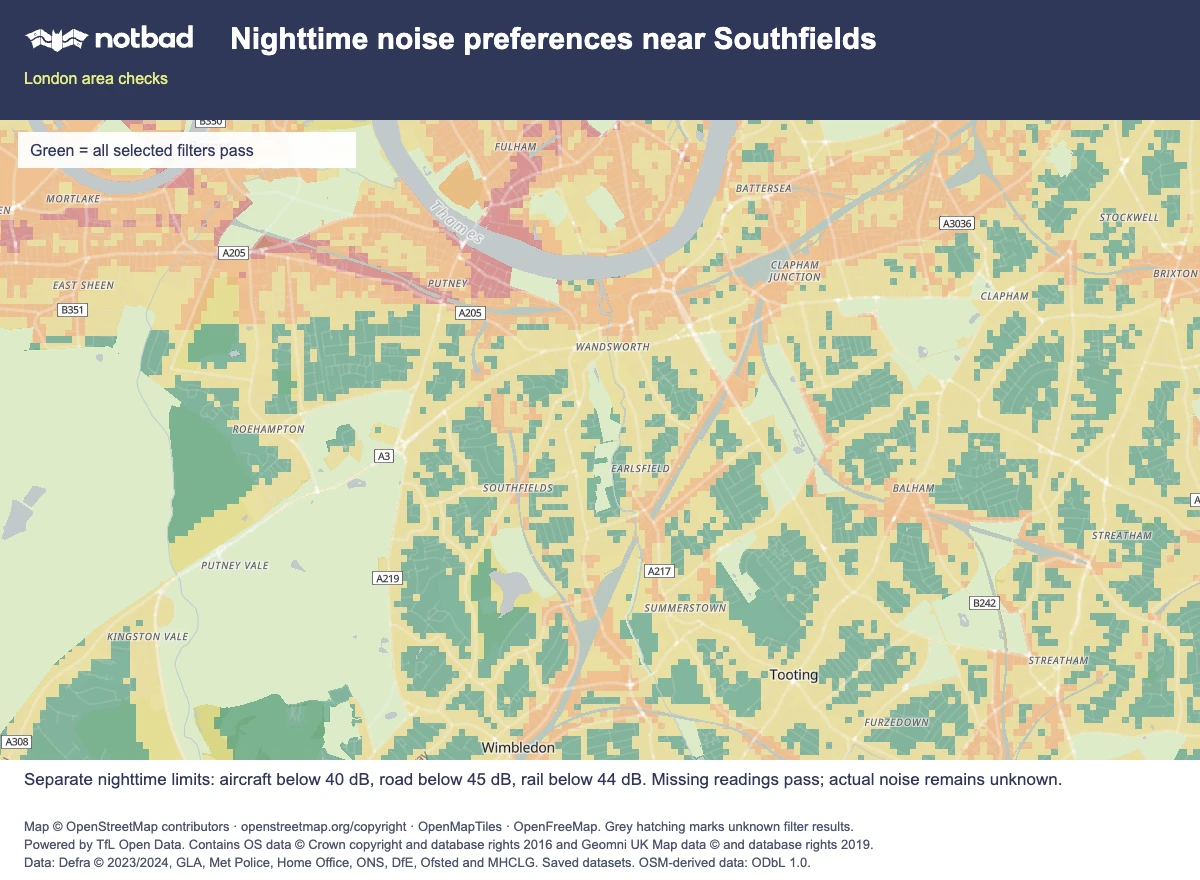
3 applied preferences · green means all selected filters pass
Filters: Aircraft noise: Night · below 40 dB; Road noise: Night · below 45 dB; Railway noise: Night · below 44 dB.
Open this exact map searchExample search, not a home recommendation. Saved data may change. Areas without a mapped noise reading pass the corresponding noise filter. Their actual noise levels remain unknown. A missing aircraft contour may mean a value below the published contours or a place outside coverage. Frequent or loud overflights are still possible.
Map © OpenStreetMap contributors · OpenMapTiles · OpenFreeMap. Map and data sources.
Two Wandsworth points show a family trade-off
Two public reference points around Southfields and King George's Park combine different school walks with different noise averages:
| Public reference point | Nearest school in the example report | Green-space walk | Modelled nighttime road noise |
|---|---|---|---|
| Southfields station point | Sheringdale Primary School: about 3 min | Wimbledon Park: about 8 min | 50.5 dB |
| King George's Park point | Anglo Portuguese School of London, primary: about 9 min | King George's Park: about 1 min | 39.9 dB |
Source: notbad's Wandsworth example reports. These are public positions, not homes; the second is inside the park, away from a residential entrance. Walks use saved routes from 30 October 2026 and an assumed pace of 80 metres per minute, rounded down to whole minutes. Property-to-street access is assumed. Road-noise figures are outdoor model averages based on 2021 activity, rounded to one decimal place.
At the park point, the lower road-noise average comes with a longer walk to the school named in the report. Investigate nearby homes if that trade-off appeals, checking eligibility, the playground's condition and the actual bedroom separately.
Check railway noise too: the nighttime averages are 62.2 dB at the Southfields station point and 37.5 dB at the park point. They use the same historical activity year. Keep them separate from the road averages; adding the values together would be misleading.
Listen at your child's bedtime
notbad's daytime noise measure covers 07:00 to 23:00; nighttime covers 23:00 to 07:00. If your child goes to bed earlier, investigate that early-evening period separately.
Read both periods and each relevant source. Defra's explanation describes long-term modelled exposure. An average cannot tell you whether a particular vehicle, train or flyover would interrupt your child's sleep on a given evening.
At the viewing, ask to compare sound with the child's bedroom window open and shut. Try to return around bedtime. Listen for neighbours, deliveries and nearby evening activity too; they are outside the transport-noise layers.
Use the heat and open-window checklist to ask how the room stays comfortable if noise prevents opening the window.
"No mapped aircraft-noise contour" means the location may be below published contours or outside coverage. Frequent or loud overflights are still possible, so include aircraft in your listening check.
Test the journeys as a family
Try the actual routes at your family's pace. notbad's assumed walking speed cannot predict how quickly your children will walk, and routes are not checked for pushchair or step-free suitability.
The school, park and shop estimates each start around the selected point. For a home-to-school-to-playground-to-shop afternoon, test the whole sequence separately; those individual estimates do not describe the circuit.
Walk both ways. Look for somewhere to buy groceries on the route and somewhere to wait if you arrive early. Consider whether one adult could manage the children and bags on the journey.
For a household relying on walking and public transport, the London without a car examples show how those everyday destinations can fit together.
A family viewing checklist
- Confirm the school phase, admissions arrangements, availability and pupil entrance.
- Walk to the park entrance and facility you would use, checking access and current opening information.
- Listen from the bedroom at a relevant time, compare open and closed windows, and ask how the room stays comfortable in summer.
- Try the crossings, gates and pavements with your children or pushchair, at your own pace.
- Check the parent's complete onward trip and return for collection, including childcare arrangements.
On the notbad map, compare school, park, station and supermarket walks alongside separate noise preferences. Search the prospective home's postcode and refine its representative point. Use the readings to prepare visits to shortlisted homes; passing selected filters cannot certify a quiet bedroom or suitability for your family.