Too hot to close the windows, too noisy to sleep: choosing a London flat for summer
Too hot with the windows shut, too noisy with them open? Check bedroom noise, airflow, shade and cooling before choosing a London flat.
By the notbad project · reviewed . Data dates are listed separately.
Check the noise around a homeIn this guide
A quiet viewing with the windows shut can leave a summer problem undiscovered. If opening the bedroom window lets in cooler air and noise you cannot tolerate, how will you cool the room?
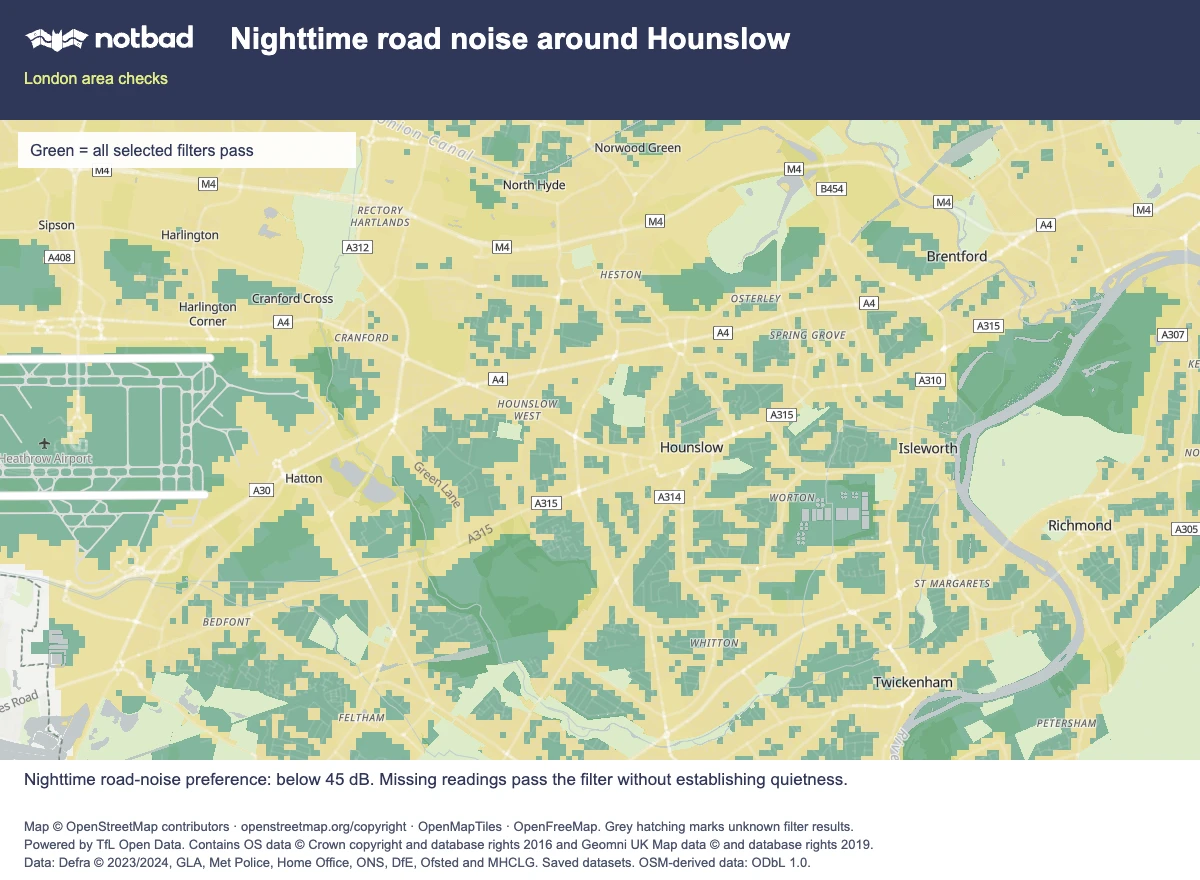
1 applied preferences · green means all selected filters pass
Filters: Road noise: Night · below 45 dB.
Open this exact map searchExample search, not a home recommendation. Saved data may change. Areas without a mapped noise reading pass the corresponding noise filter. Their actual noise levels remain unknown.
Map © OpenStreetMap contributors · OpenMapTiles · OpenFreeMap. Map and data sources.
Ask that before signing, even on a cool day. Listen with the window open, find out how the flat performs in summer and use outdoor noise maps to identify sources worth checking.
Opening the window helps only under the right conditions
The UK Health Security Agency advises opening windows when it is safe and cooler outside, including at night, to encourage airflow. Its keep-cool-at-home checklist identifies homes more prone to overheating, including top-floor flats, homes with windows on only one side, restricted openings and large unshaded windows.
At the viewing, check how far the windows open and whether air can flow through the home. Find out where the afternoon sun falls and how the bedroom is intended to stay comfortable with the window shut.
Westminster's noise and overheating guidance says that when noise requires closed windows, overheating should be assessed with those windows closed and alternative ventilation considered. Ask how that design principle is addressed in the flat you are viewing.
Listen from the room you would sleep in
With the agent's permission, open the bedroom window as far as you would use it. Listen from inside the room, then shut it and compare. A pause in conversation makes the background and individual events easier to hear.
What makes you want to close it? Listen for continuous road sound and occasional accelerations, passing trains or aircraft. Voices from a nearby venue and a building's ventilation equipment may need a different follow-up visit from commuter traffic.
An afternoon appointment cannot establish nighttime conditions. Where practical, return at a relevant time, including an evening or weekend if nearby activity makes that important.
Listen from rear-facing rooms too. Ask what they face and whether equipment, access routes or neighbouring uses could affect them.
A lower road reading does not settle the aircraft question
At two public Hounslow points, the road averages differ much more than the aircraft averages:
| Public reference location | Modelled daytime road noise | Mapped daytime aircraft noise |
|---|---|---|
| Hounslow West station point | 66.9 dB | 57.3 dB |
| Hounslow Heath reference point | 41.2 dB | 56.4 dB |
Source: notbad's Hounslow example reports, rounded to one decimal place. The Heath point is inside the green space, not at a home. These separate outdoor averages cannot be added together or treated as bedroom measurements.
The lower road average at the Heath point leaves an aircraft question to investigate. For a prospective home, check each relevant source and listen at the window you would use.
The road figures come from Defra's Round 4 modelling based on 2021 activity. The retained aircraft figures are from the 2022 mapping edition; the activity year has not been established for every airport. Both columns describe historical averages, leaving tonight's conditions to investigate.
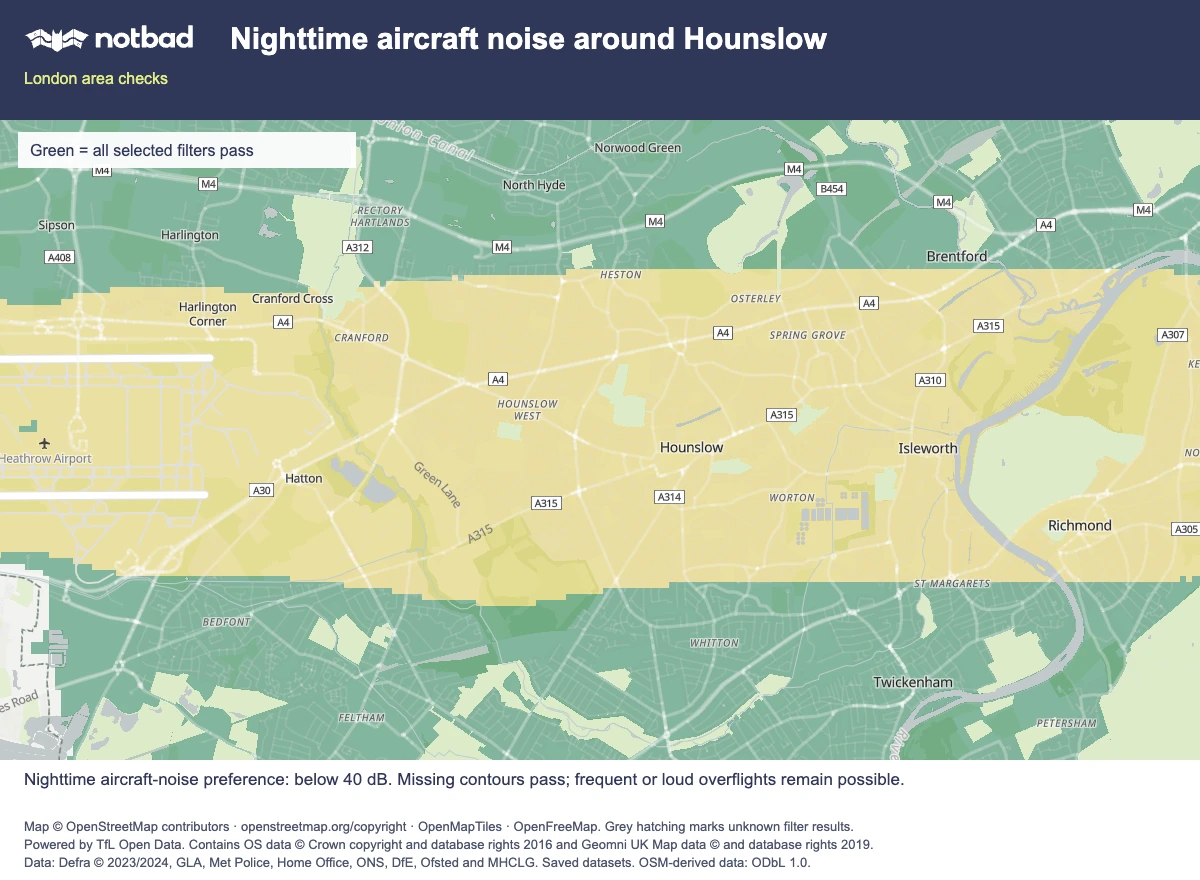
1 applied preferences · green means all selected filters pass
Filters: Aircraft noise: Night · below 40 dB.
Open this exact map searchExample search, not a home recommendation. Saved data may change. Areas without a mapped noise reading pass the corresponding noise filter. Their actual noise levels remain unknown. A missing aircraft contour may mean a value below the published contours or a place outside coverage. Frequent or loud overflights are still possible.
Map © OpenStreetMap contributors · OpenMapTiles · OpenFreeMap. Map and data sources.
Read the nighttime evidence before making a sleep decision
For a sleep decision, read the nighttime figure alongside the daytime one. notbad's daytime measure covers 07:00 to 23:00; nighttime covers 23:00 to 07:00.
These long-term road and rail averages model outdoor exposure on a 10-metre grid, at four metres above ground. They cannot reproduce a particular evening or predict sound inside your room. Defra's explanation of the noise maps describes how the models work.
An average does not identify the loudest individual event. It cannot tell you whether a train, vehicle or flyover would disturb you, how often a sound will occur tonight, or how the building and window affect what you hear. Even a low nighttime average needs a listening check before you rely on an open window for sleep.
For a child's earlier bedtime, follow the family-home checks: the nighttime average starts at 23:00 and does not isolate the early evening.
A blank aircraft map does not establish silence
Where notbad says "No mapped aircraft-noise contour", the location may be below published contours or outside coverage. Frequent or loud overflights are still possible. The missing value establishes neither flight frequency nor a zero-decibel reading.
Investigate neighbours, music, deliveries, building work and mechanical equipment directly; they are outside the transport-noise layers.
The separate Tube-track proximity check is a distance proxy, not an indoor vibration measurement. The noise guide explains its source and coverage.
For help comparing records from different publishers, read how to research a London neighbourhood.
Ask how the flat works when the window is shut
A "double glazed" description tells you little about cooling with the window closed. Ask the landlord or agent to demonstrate any ventilation or cooling system and explain what it does: cool the air, bring outdoor air in or extract air.
Check the controls, maintenance and operating arrangements. If the flat relies on opening windows, establish whether that is practical in the bedroom at night.
Ask previous occupants how the flat feels through a hot spell if you have the opportunity. Request any available overheating assessment and information about changes to shading, windows or ventilation.
Five checks to take to the viewing
- Compare the sound with the bedroom window open and shut, listening from where you would sleep.
- Check opening restrictions and whether windows on another side can also open safely to allow airflow.
- Identify rooms exposed to afternoon sun and the shading available.
- Ask how ventilation and cooling work when noise prevents open-window use.
- Arrange a second observation for sources or activities the visit did not capture.
Before the appointment, check the postcode on notbad, refine the location and inspect the separate road, rail and aircraft readings, including nighttime. Use them to prepare your questions. The report cannot assess the flat's overheating risk or certify its bedroom as quiet.